Skin Cancer

Your skin is the body’s largest organ. It’s also the most exposed, making it vulnerable to rashes, sunburns, injuries, infections, and other disorders. Like internal organs, the skin can have complex conditions that require advanced treatment. Whether you’re born with a skin condition or you’re coping with damage from the sun or environment, we can help. ASCI is dedicated to providing the highest quality services in cosmetic, medical, and surgical dermatology.
ASCI offers a full range of skin care services, from preventive screenings to the latest treatments utilizing state-of-the-art-technology. Our staff is fully qualified in the treatment of all types of skin conditions, including skin cancer, moles, acne, and Mohs micrographic surgery.
Patients throughout the Central Valley count on ASCI to treat common conditions such as acne, eczema, and skin allergies, as well as complex and uncommon skin disorders. We offer our patients a team of board-certified dermatologists with extensive experience and diverse, unique capabilities. Together, we are committed to meeting any and all of your dermatologic needs with expertise, thoroughness, and above all – compassion.
Mohs Micrographic Surgery
Mohs micrographic surgery has a success rate of 98% for both initial and retreatment of certain types of skin cancers. It is frequently used for lesions on the head, face, hands, neck, and hard-to-reach anatomical locations. Mohs surgery enables your specially trained, certified surgeon to remove tissue in stages, precisely identifying and removing tumor cells while preserving the healthy surrounding tissue.
Mohs surgery is most often done in an outpatient setting. In many cases, patients need only 2 or 3 repeated procedures. While more commonly used to treat squamous cell carcinoma and basal cell carcinoma, it can also be used to treat melanoma in certain cases.
Cryosurgery
Cryosurgery can be used to treat age spots, skin growths (warts and skin tags) and early stage basal and squamous cell carcinomas. During the procedure, liquid nitrogen is used to remove damaged skin cells. The doctor will apply frozen nitrogen using either a cotton swab or a spray device. The goal is to freeze the skin quickly and then allow it to slowly thaw, causing maximum destruction to the targeted skin cells. In some cases, additional applications may be needed.
One of the major advantages of this simple, low-risk procedure is that it can be used at any time during a visit to a doctor. For small lesions, liquid nitrogen can be applied using a cotton-tipped applicator, metal probe, or with a spray in fewer than 30 seconds. Larger lesions may require longer freezing cycles lasting 30–60 seconds. Because liquid nitrogen is extremely cold, the treated area turns white from frost. Most patients experience temporary pain during the treatment, with a minor throbbing sensation after the procedure.
Surgical Excision
A surgical excision, also known as a shave excision, is a skin cancer treatment that surgically removes malignant moles, lesions, and tumors along with a healthy margin around the excised area.
Surgical excisions can be performed for certain types of cancers, whether to remove the entire tumor, or to take a biopsy for further study. Our expert surgeons perform surgical excisions in ways that maximize the cosmetic outcome while minimizing scarring and functional impairment.
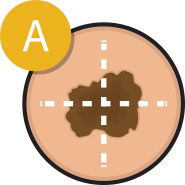
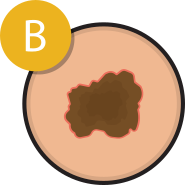
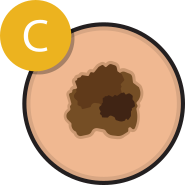
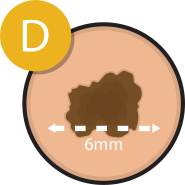
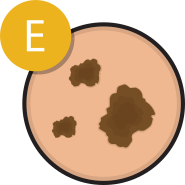
Spot the signs of skin cancer.
Conduct regular self-exams for new or different looking growths on your skin. Check for spots, scabs, or moles that are new or unusual-looking, bleeding, or heal poorly.